Month-end close
Close is late because AP is still coding. And nobody can see it.
A faster close is not a discipline problem. It is a visibility problem. You cannot shorten a process whose bottleneck you can only find by asking around.
40 hours a month back, per AP team, at a 24,000 unit portfolio.
Visibility
Four numbers that shorten a close.
Each one answers a question a Controller currently answers by asking a person.
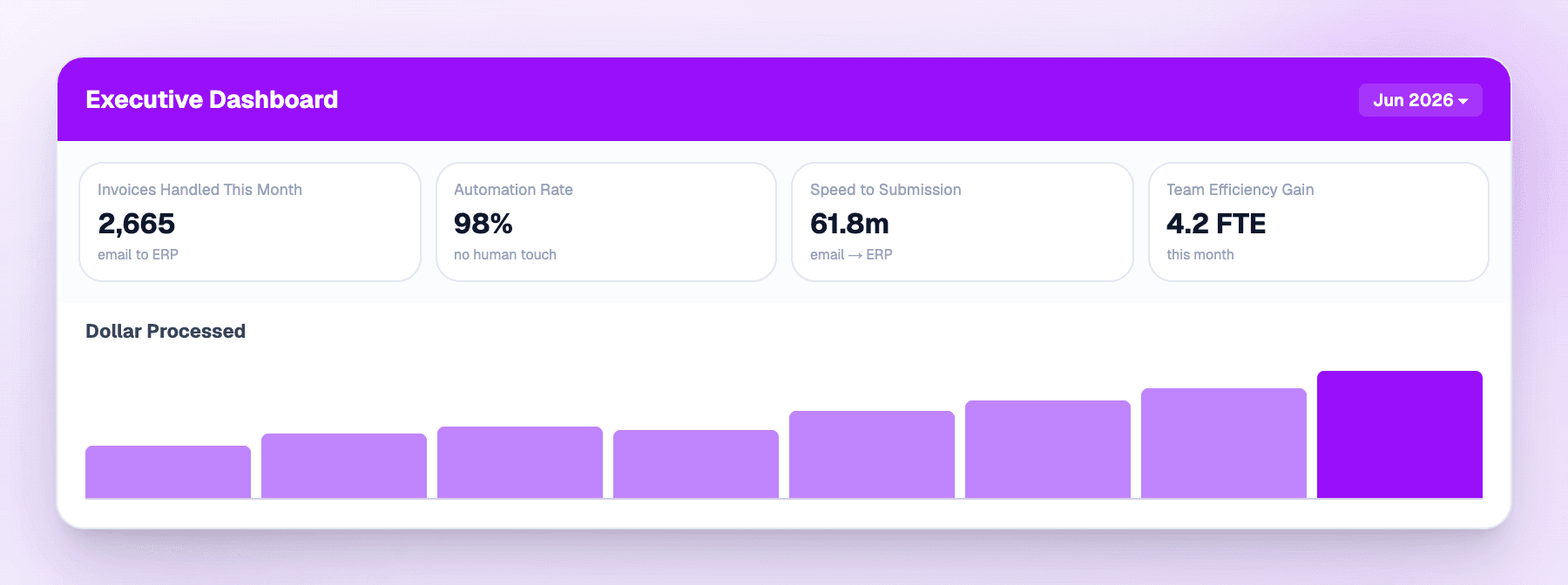
Speed to submission
Time from email receipt to ERP submission, measured across every property rather than estimated from memory.
Error queue exposure
How many invoices are stuck, the dollar value sitting in them, and how long it has been there.
Month over month
Current month against last month on the same tiles, so a regression shows up while you can still do something about it.
Audit trail
Capture, coding, approval, and posting, timestamped and attributed. Reviews stop being a reconstruction exercise.
The close checklist
What has to be true on the last day.
Every item here is a query rather than a conversation once capture, coding, and approval run in one place.
Every invoice received this month is captured and accounted for
Nothing is sitting unapproved past its aging threshold
The error queue is worked down, with the dollar exposure known
Accruals reflect purchase orders received but not yet invoiced
Coding is consistent with prior months, per property
The audit trail is complete without anyone assembling it
Each of the six, with what to pull and where it usually breaks, is in the multifamily month-end close checklist.
A worked last day
Take a portfolio submitting 2,500 invoices a month, the calculator default. At a 98% automation rate, meaning invoices that require no human touch, the close review is 50 invoices.
- Invoices submitted
- 2,500
- Posted with no human touch
- 2,450
- Left for the team to work
- 50
The 2,500 is an input. Put your own volume there and the split moves with it. The 98% is what the 24,000 unit reference portfolio measured.
BillRoute has significantly reduced the administrative burden on our teams while improving invoice visibility and internal controls. It has removed a lot of day-to-day friction and made the process far easier to manage.
Chris Nissen
VP of Finance
FAQ
Close questions
What actually makes close late?
How much faster does close get?
Does this work across multiple entities?
What does a CFO see that a Controller does not?
Show us your last close.
Where it stalled, and for how long. We will show you which of those stalls BillRoute removes and which ones it does not.